Introduction
- Automation in clinical biochemistry refers to the use of automated instruments, computer systems, and integrated laboratory technologies to perform biochemical tests with minimal manual intervention.
- It has transformed clinical laboratories by improving the speed, accuracy, precision, and efficiency of laboratory testing.
- Automated systems can perform several stages of laboratory testing, including sample identification, sample preparation, reagent handling, analysis, result calculation, and reporting.
- Clinical biochemistry laboratories commonly use automation for the measurement of glucose, urea, creatinine, bilirubin, proteins, enzymes, lipids, electrolytes, and many other biochemical parameters.
- Automation helps laboratories process a large number of samples while maintaining standardized testing conditions.
- Modern laboratories may use stand-alone analyzers, modular systems, total laboratory automation (TLA), and laboratory information systems (LIS).
- Automation also reduces repetitive manual work and allows laboratory professionals to focus more on quality control, result interpretation, troubleshooting, and patient safety.
- Therefore, automation has become an essential component of modern clinical biochemistry and diagnostic laboratory services.
Components
An automated laboratory generally consists of several interconnected components.
1. Sample Collection and Identification
- Patient specimens are collected in appropriate containers and identified using patient information and barcodes.
- Correct sample identification is essential because an error at this stage can affect the entire testing process.
2. Sample Transport System
- Samples may be transported manually or through automated systems such as conveyor belts, tracks, or other laboratory transport mechanisms.
- The purpose is to move specimens efficiently from the receiving area to the appropriate analytical instruments.
3. Sample Processing System
Automated systems may perform or assist with:
- Sample sorting
- Centrifugation
- Aliquoting
- Decapping
- Sample distribution
- Sample routing
These processes reduce manual handling and improve workflow efficiency.
4. Automated Analyzer
- The analyzer performs biochemical tests using programmed analytical procedures.
It may automatically:
- Identify the sample
- Add reagents
- Mix samples and reagents
- Perform the reaction
- Measure the analytical signal
- Calculate the result
- Store the result
5. Computer and Laboratory Information System
- The Laboratory Information System (LIS) manages laboratory data and may communicate with automated analyzers.
It can support:
- Patient registration
- Test orders
- Sample tracking
- Result transmission
- Result verification
- Report generation
- Data storage
Types of Automation
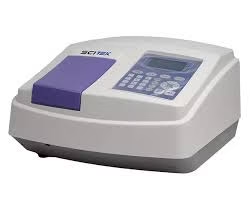
1. Semi-Automated Systems
- Semi-automated analyzers perform some steps automatically, while other steps require manual intervention.
Features
- Some analytical processes are automated.
- Sample preparation may be performed manually.
- Suitable for laboratories with relatively lower workloads.
- Requires greater involvement of laboratory personnel than fully automated systems.
2. Fully Automated Systems
- Fully automated analyzers perform most analytical steps with minimal manual intervention.
Features
- Automatic sample identification
- Automatic reagent handling
- Automatic sample and reagent dispensing
- Automatic measurement
- Automatic calculation
- Automatic result generation
These systems are particularly useful in laboratories with high sample volumes.
3. Modular Automation
- Modular systems combine different analytical modules into a coordinated laboratory platform.

For example, different modules may be used for:
- Clinical chemistry
- Immunoassays
- Electrolytes
- Other specialized investigations
The modules can work together to improve laboratory workflow.
4. Total Laboratory Automation (TLA)
- Total Laboratory Automation integrates multiple laboratory processes into a coordinated automated workflow.

It may include:
Sample Reception → Sorting → Centrifugation → Aliquoting → Analysis → Storage → Reporting
TLA is generally used in large laboratories where a high volume of specimens must be processed efficiently.
Automation Workflow
Pre-Analytical Phase
- The pre-analytical phase is the stage of laboratory testing that occurs before the actual biochemical analysis of a patient sample.
- It includes all activities from test ordering and patient preparation to sample collection, identification, transportation, processing, and preparation for analysis.
- In an automated clinical biochemistry laboratory, proper management of the pre-analytical phase is essential because errors occurring at this stage can affect the accuracy and reliability of the final laboratory result.
Steps in the Pre-Analytical Phase
- Test Request and Patient Identification
- The appropriate laboratory test is requested based on the clinical requirement.
- The patient is correctly identified using appropriate identifiers.
- Accurate identification helps prevent sample mix-ups and reporting errors.
- Patient Preparation
- The patient may require specific preparation depending on the test.
- Factors such as fasting status, medications, posture, exercise, and time of sample collection may influence certain biochemical results.
- Sample Collection
- The appropriate specimen, usually blood or urine, is collected using a suitable container.
- Correct collection technique helps prevent problems such as hemolysis, clotting, or insufficient sample volume.
- Sample Labeling and Barcode Identification
- The specimen is labeled with the required patient and sample information.
- In automated laboratories, barcode systems help provide accurate sample identification and traceability.
- Sample Transportation
- Samples are transported from the collection area to the laboratory under appropriate conditions.
- Proper handling helps preserve the integrity and stability of the specimen.
- Sample Reception and Sorting
- On arrival, samples are checked for identification, suitability, and requested investigations.
- Automated systems may sort and route samples to the appropriate analytical platform.
- Centrifugation and Sample Separation
- Blood samples may be centrifuged to separate serum or plasma from blood cells when required.
- Automated systems can perform or assist with centrifugation and sample preparation.
- Aliquoting and Sample Preparation
- When necessary, specimens may be divided into smaller portions called aliquots for different tests or analyzers.
- Automated aliquoting can reduce manual handling and improve workflow.
Common Pre-Analytical Errors
Important errors that may occur during this phase include:
- Patient misidentification
- Incorrect or missing sample labeling
- Hemolyzed specimens
- Insufficient sample volume
- Incorrect collection container
- Clotted samples when anticoagulated specimens are required
- Improper sample storage
- Delayed transportation
- Incorrect patient preparation
- Contamination of specimens
Role of Automation in the Pre-Analytical Phase
Automation can improve the pre-analytical workflow through:
- Barcode-based sample identification
- Automated sample sorting
- Automated transportation
- Automated centrifugation
- Automated decapping
- Automated aliquoting
- Automated sample routing
- Sample tracking through the laboratory information system
Analytical Phase
- The analytical phase is the stage of laboratory testing in which the patient specimen is actually analyzed using a specific laboratory method and instrument.
- In an automated clinical biochemistry laboratory, this phase involves the measurement of biochemical parameters under standardized and controlled conditions.
- Automation minimizes repetitive manual operations and helps ensure speed, precision, accuracy, and reproducibility of biochemical analysis.
Steps in the Analytical Phase
- Sample Identification
- The analyzer identifies the patient sample using a barcode or sample identification system.
- The system matches the sample with the requested investigations.
- Sample Aspiration
- The analyzer automatically aspirates a precise volume of patient sample.
- Automated pipetting helps reduce errors associated with manual volume measurement.
- Reagent Selection and Addition
- Appropriate reagents are selected according to the programmed test.
- The analyzer dispenses the required amounts of sample and reagents into a reaction vessel.
- Mixing and Incubation
- The sample and reagents are mixed to initiate the biochemical reaction.
- Where required, the reaction mixture is maintained at a specified temperature and incubation period.
-
Measurement of the Reaction
The analyzer measures the analytical signal produced by the reaction using an appropriate detection principle.
Common principles include:
- Spectrophotometry
- Turbidimetry
- Potentiometry
- Ion-selective electrode (ISE) technology
- Result Calculation
- The instrument processes the measured signal and converts it into a quantitative test result using programmed calibration data and analytical algorithms.
- Quality Control Monitoring
- Quality-control materials are analyzed at defined intervals to monitor analytical performance.
- Quality control helps detect problems related to reagents, calibration, instrument performance, or analytical processes.
- Result Validation
- Results are reviewed according to laboratory procedures.
- Abnormal, unexpected, or questionable results may require further investigation or repeat analysis.
Common Biochemical Parameters Analyzed
Automated clinical biochemistry analyzers can measure a wide range of parameters, including:
- Glucose
- Urea
- Creatinine
- Uric acid
- Bilirubin
- Total protein
- Albumin
- ALT and AST
- Alkaline phosphatase
- Cholesterol
- Triglycerides
- Sodium
- Potassium
- Chloride
- Calcium
- Phosphate
Role of Automation in the Analytical Phase
Automation helps to:
- Perform precise sample and reagent dispensing.
- Standardize analytical procedures.
- Process multiple samples simultaneously or sequentially at high throughput.
- Reduce repetitive manual operations.
- Automatically calculate and record results.
- Integrate instruments with the Laboratory Information System (LIS).
- Monitor analytical performance through quality-control procedures.
- Improve turnaround time and workflow efficiency.
Post-Analytical Phase
- The post-analytical phase is the stage of laboratory testing that occurs after the biochemical analysis has been completed.
- It includes the processes involved in reviewing, validating, reporting, communicating, and storing laboratory results.
- In an automated clinical biochemistry laboratory, effective post-analytical processes help ensure that accurate results reach the appropriate healthcare professionals in a timely and reliable manner.
Steps in the Post-Analytical Phase
- Result Verification
- The generated results are reviewed to identify unexpected, inconsistent, or technically questionable values.
- Results may be checked against laboratory-defined rules before release.
- Result Validation
- Results are validated according to established laboratory protocols and quality requirements.
- Abnormal or doubtful results may require repeat analysis or further investigation.
- Result Transmission
- Validated results can be electronically transferred from the analyzer to the Laboratory Information System (LIS).
- Automated data transfer reduces manual transcription and associated errors.
- Result Reporting
- Final laboratory reports are generated and made available to the appropriate healthcare professionals.
- Reports generally include the test result, units, reference information, and relevant laboratory comments, as applicable.
- Critical Result Communication
- Results that meet predefined critical-value criteria require prompt communication according to laboratory policy.
- Proper documentation of critical-result communication is an important part of patient safety.
- Sample Storage and Retention
- After testing, specimens may be stored for a defined period according to the laboratory’s policies and the type of specimen.
- Stored samples may be retrieved when repeat or additional testing is required.
- Data Storage and Record Management
- Laboratory results are stored electronically through the LIS or other laboratory information systems.
- Proper data management allows authorized personnel to retrieve previous results when clinically appropriate.
Role of Automation in the Post-Analytical Phase
Automation can assist with:
- Automatic transfer of results from analyzers to the LIS.
- Result flagging for abnormal or out-of-range values.
- Automated application of predefined validation rules.
- Generation of laboratory reports.
- Sample tracking and storage management.
- Maintaining electronic laboratory records.
- Reducing manual transcription errors.
- Improving turnaround time and workflow efficiency.
Common Post-Analytical Errors
Errors may occur due to:
- Incorrect result transcription
- Failure to review abnormal results
- Incorrect patient or sample identification
- Delayed reporting
- Failure to communicate critical results
- Incorrect reference intervals or units
- Inappropriate result release
- Errors in data transmission or information-system interfaces
Principles of Automated Biochemical Analysis
Automated biochemical analyzers use different analytical principles depending on the test.
1. Spectrophotometry
- Measures the amount of light absorbed by a substance or reaction product at a specific wavelength.
- Applications: Glucose, bilirubin, proteins, and many enzyme assays.
2. Turbidimetry
- Measures the reduction or scattering of light caused by particles suspended in a sample.
- Applications: Measurement of certain proteins and immune-related analytes.
3. Potentiometry
- Measures electrical potential differences between electrodes.
- Applications: Measurement of electrolytes such as:
- Sodium
- Potassium
- Chloride
4. Ion-Selective Electrode (ISE) Technology
- Uses selective electrodes to measure specific ions in biological samples.
- It is widely used for electrolyte analysis in clinical laboratories.
Use of Automation in Clinical Biochemistry
1. High-Volume Sample Processing
- Automation allows laboratories to process large numbers of patient specimens efficiently.
- This is particularly valuable in hospitals, diagnostic centers, and reference laboratories.
2. Routine Biochemical Testing
Automated systems are widely used for routine measurement of biochemical parameters such as:
- Glucose
- Urea
- Creatinine
- Bilirubin
- Proteins
- Enzymes
- Lipids
- Electrolytes
3. Emergency Testing
- Automation can support rapid processing of urgent biochemical investigations required in emergency and critical-care settings.
Examples include:
- Glucose
- Electrolytes
- Creatinine
- Cardiac-related biochemical markers on appropriate platforms
4. Quality Control
- Automated systems can support laboratory quality-control procedures by allowing regular analysis of quality-control materials and monitoring analytical performance.
Quality-control data can help identify:
- Analytical errors
- Reagent problems
- Instrument problems
- Calibration issues
- Changes in assay performance
5. Sample Tracking
- Barcode systems and automated sample-management systems allow laboratories to track specimens throughout the testing process.
- This improves traceability and reduces the possibility of sample mix-ups.
6. Result Management and Reporting
- Automated analyzers can transmit test results to laboratory computer systems.
This helps with:
- Result storage
- Result verification
- Report generation
- Electronic transmission
- Patient record management
7. Reflex and Repeat Testing
- Depending on laboratory rules and analyzer capabilities, automated systems may perform programmed repeat or reflex testing when predefined criteria are met.
- This can improve workflow and reduce unnecessary manual intervention.
Advantages
- High Throughput: Large numbers of samples can be processed efficiently.
- Improved Precision: Automated pipetting and standardized procedures reduce variation.
- Increased Speed: Many tests can be completed rapidly.
- Reduced Manual Errors: Minimizes errors associated with repetitive manual operations.
- Standardization: Testing conditions and analytical procedures can be consistently maintained.
- Reduced Reagent and Sample Handling: Automated systems can use precise volumes of samples and reagents.
- Better Sample Traceability: Barcode systems improve identification and tracking.
- Efficient Data Management: Results can be transferred directly to laboratory information systems.
- Improved Laboratory Productivity: Staff can spend more time on tasks requiring professional judgment.
- Continuous Workflow: Integrated systems can streamline the movement of samples through the laboratory.
Limitations
- High Initial Cost: Automated analyzers and laboratory automation systems require significant investment.
- Maintenance Requirements: Instruments require regular maintenance, calibration, and servicing.
- Technical Expertise: Skilled personnel are required for operation, troubleshooting, and quality management.
- Instrument Downtime: Equipment failure can interrupt laboratory workflow.
- Dependence on Consumables: Continuous availability of reagents, calibrators, controls, and other supplies is essential.
- Limited Flexibility: Highly standardized systems may be less convenient for unusual or specialized testing.
- Risk of Systematic Errors: An instrument or software problem can potentially affect many samples if not detected promptly.
- Need for Quality Control: Automation does not eliminate the need for professional oversight and quality assurance.
- Infrastructure Requirements: Large automated systems may require adequate space, power, environmental control, and technical support.
Role of Laboratory Professionals
Automation does not replace the need for qualified laboratory professionals. Instead, it changes the nature of their responsibilities.
Laboratory professionals are responsible for:
- Proper specimen handling
- Instrument operation
- Calibration and maintenance
- Quality control
- Troubleshooting
- Review of abnormal or questionable results
- Result validation
- Interpretation within the laboratory’s scope
- Quality assurance
- Patient safety
Therefore, automation supports laboratory professionals but does not replace professional judgment.
Automation and Quality Assurance
Automation contributes to quality assurance by standardizing many laboratory processes. However, reliable laboratory results require quality management throughout the entire testing process.
Important areas include:
Pre-analytical quality
→ Correct patient identification
→ Proper specimen collection
→ Correct sample handling
Analytical quality
→ Calibration
→ Internal quality control
→ Reagent monitoring
→ Instrument maintenance
Post-analytical quality
→ Result verification
→ Correct reporting
→ Timely communication of critical results
Thus, automation should be considered part of a complete laboratory quality-management system, rather than a substitute for it.
Automation in Modern Clinical Biochemistry
Modern clinical biochemistry is increasingly moving toward integrated and intelligent laboratory systems.
Current developments include:
- Total laboratory automation
- Automated sample transportation
- Barcode and tracking systems
- Integrated chemistry and immunoassay platforms
- Advanced laboratory information systems
- Automated quality-control monitoring
- Digital result management
- Middleware-based laboratory connectivity
- Increasing use of data analytics and intelligent decision-support systems
These technologies aim to improve efficiency, standardization, turnaround time, and patient safety.