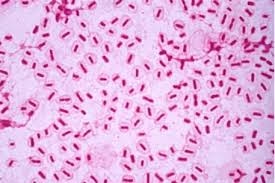
Introduction
Bacteria are prokaryotic, unicellular microorganisms that play essential roles in health, disease, environment, and biotechnology. They are widely distributed in soil, water, air, and living organisms. Understanding bacterial classification, morphology, structure, chemical composition, and ecological importance is fundamental in microbiology and medical sciences.
This blog discusses:
-
Classification of bacteria
-
Morphology (Cocci and Bacilli – Gram positive and Gram negative)
-
Bacterial structure
-
Chemical composition
-
Plasmids
-
Microsomes
-
Cytoplasmic inclusions
-
Growth and reproduction
-
Microbial ecology
Classification of Bacteria
Bacteria can be classified based on various criteria:
A. Based on Shape
-
Cocci – Spherical
-
Bacilli – Rod-shaped
-
Spiral forms – Spirilla, spirochetes
-
Vibrios – Comma-shaped
B. Based on Gram Staining
Developed by Hans Christian Gram
-
Gram-positive bacteria – Retain crystal violet (purple)
-
Gram-negative bacteria – Take counterstain (pink/red)
C. Based on Oxygen Requirement
-
Obligate aerobes
-
Obligate anaerobes
-
Facultative anaerobes
-
Microaerophilic
D. Based on Spore Formation
-
Spore-forming bacteria
-
Non-spore-forming bacteria
Morphology of Bacteria
A. Cocci
Arrangement of Cocci
-
Diplococci – Pairs
-
Streptococci – Chains
-
Staphylococci – Clusters
-
Tetrads – Groups of four
-
Sarcinae – Cubical packets
1. Gram-Positive Cocci
Examples:
-
Staphylococcus aureus
-
Streptococcus pyogenes
-
Enterococcus faecalis
Characteristics:
-
Thick peptidoglycan layer
-
Teichoic acids present
-
No outer membrane
2. Gram-Negative Cocci
Examples:
-
Neisseria gonorrhoeae
-
Neisseria meningitidis
Characteristics:
-
Thin peptidoglycan layer
-
Outer membrane present
-
Lipopolysaccharide (LPS)
B. Bacilli (Rod-Shaped Bacteria)

Bacilli are rod-shaped bacteria.
1. Gram-Positive Bacilli
Examples:
-
Bacillus anthracis
-
Clostridium tetani
-
Corynebacterium diphtheriae
Characteristics:
-
Thick peptidoglycan
-
Some form spores
-
No outer membrane
2. Gram-Negative Bacilli
Examples:
-
Escherichia coli
-
Salmonella typhi
-
Pseudomonas aeruginosa
Characteristics:
-
Thin peptidoglycan
-
Outer membrane
-
Endotoxin (LPS)
Structure of Bacterial Cell
Bacteria are prokaryotes and lack a true nucleus.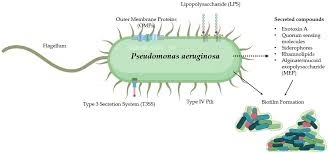
Main Components
-
Cell wall – Provides shape and rigidity
-
Plasma membrane – Selective permeability
-
Cytoplasm – Contains enzymes and ribosomes
-
Nucleoid – Circular DNA
-
Ribosomes (70S) – Protein synthesis
-
Capsule – Protection from phagocytosis
-
Flagella – Motility
-
Pili/Fimbriae – Attachment
Chemical Composition of Bacteria
Bacterial cells contain:
-
Water (70–80%)
-
Proteins
-
Lipids
-
Carbohydrates
-
Nucleic acids
-
Inorganic salts
Cell Wall Composition
-
Gram-positive: Thick peptidoglycan + teichoic acid
-
Gram-negative: Thin peptidoglycan + outer membrane + LPS
Plasmids
Plasmids are:
-
Small circular extrachromosomal DNA
-
Capable of independent replication
Functions:
-
Antibiotic resistance (R plasmids)
-
Toxin production
-
Virulence factors
Plasmids can transfer between bacteria via conjugation.
Microsomes
Bacteria do not have true microsomes like eukaryotic cells. However:
-
Mesosomes (membrane infoldings) were previously described
-
Involved in respiration and cell division
-
Now considered artifacts in electron microscopy
Cytoplasmic Inclusions
These are storage materials in bacterial cytoplasm:
-
Glycogen granules
-
Polyphosphate granules
-
Sulfur granules
-
Lipid inclusions
Functions:
-
Energy storage
-
Nutrient reserve
Growth and Reproduction
A. Mode of Reproduction
Bacteria reproduce by binary fission:
-
DNA replication
-
Septum formation
-
Division into two daughter cells
Generation time varies from 20 minutes (e.g., Escherichia coli) to several hours.
B. Growth Curve
Bacterial growth in culture follows four phases:
-
Lag phase
-
Log (exponential) phase
-
Stationary phase
-
Death phase
C. Factors Affecting Growth
-
Temperature
-
pH
-
Oxygen
-
Nutrients
-
Moisture
Microbial Ecology
Microbial ecology studies the interaction of microorganisms with their environment.
A. Normal Flora
-
Skin
-
Gastrointestinal tract
-
Respiratory tract
Example: Escherichia coli in intestine
B. Pathogens
Cause disease under favorable conditions.
C. Environmental Role
-
Decomposition
-
Nitrogen fixation
-
Biogeochemical cycles