Introduction
-
Labeling of histology specimens is a crucial pre-analytical step in histopathology and diagnostic laboratories.
-
It involves accurate identification and marking of:
-
Specimen containers
-
Tissue cassettes
-
Paraffin blocks
-
Histology slides
-
-
Labels must include patient-specific and specimen-specific details.
-
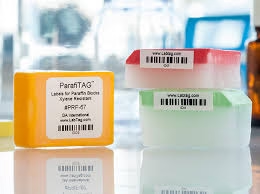
Proper labeling ensures that the tissue examined microscopically belongs to the correct patient and correct anatomical site.
-
Histopathology specimens pass through multiple steps, including:
-
Fixation
-
Processing
-
Embedding
-
Sectioning
-
Staining
-
Reporting
-
Long-term storage
-
-
At every stage, accurate labeling maintains traceability of the specimen.
-
Even a minor labeling error can result in:
-
Specimen mix-up
-
Misdiagnosis
-
Inappropriate or delayed treatment
-
Repeat invasive procedures
-
Emotional distress to patients
-
-
Labeling errors carry serious medico-legal and ethical consequences.
-
Therefore, strict labeling protocols are an essential component of laboratory quality management systems.
Importance of Labeling in Histology
- Ensures positive patient identification at every stage of laboratory processing
- Prevents mix-up of specimens, especially when multiple samples are processed simultaneously
- Maintains chain of custody and traceability from collection to final report
- Ensures correct clinicopathological correlation
- Supports accurate diagnosis and treatment planning
- Essential for quality assurance programs and laboratory accreditation
- Reduces risk of medico-legal issues and ethical violations
Information Required on Histology Labels
Each histology specimen must be labeled with clear, legible, and complete information. Incomplete or unclear labeling renders the specimen unacceptable.
Mandatory Information
- Patient’s full name
- Unique patient identification number (hospital number / laboratory accession number)
- Age and sex (recommended)
- Type of specimen (biopsy, excision, resection, organ)
- Anatomical site and laterality (right/left)
- Date and time of specimen collection
- Name or initials of the clinician or surgeon
Additional Information
- Clinical diagnosis or provisional diagnosis
- Nature of procedure (incisional biopsy, excisional biopsy)
Types of Histology Specimens Requiring Labeling
- Gross tissue specimens in fixative containers
- Cassettes containing tissue for processing
- Glass slides (routine and special stains)
- Paraffin blocks
- Archived specimens and slides
Labeling of Specimen Containers
Specimen containers are the first point of labeling and are critical in preventing errors.
- Containers must be labeled at the bedside or operating table, never afterward
- Labels should be:
- Waterproof
- Chemical-resistant
- Firmly affixed
- Handwritten labels should be written using permanent markers
- Printed or barcode labels are preferred for clarity and accuracy
- The information on the container must exactly match the requisition form
- Containers without labels or with mismatched information should be rejected according to SOPs
Labeling of Tissue Cassettes
Tissue cassettes hold small tissue pieces during processing and are exposed to harsh chemicals.
- Each cassette must be labeled with:
- Laboratory accession number
- Block number or alphabet (A, B, C, etc.)
- Labels must be:
- Resistant to formalin
- Resistant to alcohols, xylene, and paraffin wax
- Incorrect cassette labeling can lead to irreversible specimen mix-up, as tissues from different patients may be embedded together
- Double verification is recommended before processing
Labeling of Histology Slides
Histology slides are the final diagnostic material examined by the pathologist.
- Slides must be labeled on the frosted end only
- Information commonly included:
- Laboratory accession number
- Block number
- Slide number and stain (H&E, PAS, IHC, etc.)
- Labels must withstand:
- Heat during drying
- Alcohol and xylene during staining
- Mislabeling of slides may result in incorrect diagnosis even if all previous steps were correct
Manual vs Automated Labeling
Manual Labeling
- Done using handwritten labels or markers
- Advantages:
- Low cost
- Easy to implement
- Disadvantages:
- Prone to human error
- Illegible handwriting
- Time-consuming
Automated / Barcode Labeling
- Uses laboratory information systems (LIS)
- Barcode printed labels used for containers, cassettes, and slides
- Advantages:
- Minimizes labeling errors
- Enhances workflow efficiency
- Improves traceability and auditability
- Strongly recommended for high-volume laboratories
Common Labeling Errors
- Missing or incomplete patient details
- Mismatch between specimen container and requisition form
- Illegible handwriting
- Transposition of numbers or names
- Duplicate accession numbers
- Incorrect laterality or specimen site
Preventive Measures
- Implementation of standard operating procedures (SOPs)
- Mandatory double-checking at each stage of specimen handling
- Use of barcode and automated labeling systems
- Regular staff training and competency assessment
- Incident reporting and root cause analysis of labeling errors
Quality Control and Safety
- Verification of labels at:
- Receipt of specimen
- Grossing
- Embedding
- Sectioning
- Reporting
- Compliance with accreditation standards such as NABL, CAP, and ISO
- Proper documentation of labeling discrepancies and corrective actions
MCQs
1. Labeling of histology specimens is considered which type of laboratory step?
A. Analytical
B. Post-analytical
C. Pre-analytical
D. Reporting
✅ Answer: C
2. The primary purpose of labeling histology specimens is to:
A. Improve staining quality
B. Increase turnaround time
C. Ensure correct patient and specimen identification
D. Reduce reagent use
✅ Answer: C
3. Which of the following must be labeled first in histopathology?
A. Histology slide
B. Paraffin block
C. Tissue cassette
D. Specimen container
✅ Answer: D
4. Incorrect labeling of histology specimens may lead to:
A. Delay in processing only
B. Poor staining
C. Misdiagnosis and medico-legal issues
D. Increased workload
✅ Answer: C
5. Which information is mandatory on a histology specimen label?
A. Blood group
B. Patient name and unique ID
C. Diagnosis only
D. Ward number only
✅ Answer: B
6. Histology slides should be labeled on the:
A. Middle of the slide
B. Non-frosted end
C. Frosted end
D. Coverslip
✅ Answer: C
7. Tissue cassettes are labeled mainly to ensure:
A. Proper fixation
B. Accurate embedding
C. Traceability during processing
D. Faster staining
✅ Answer: C
8. Which of the following stages requires continuous verification of labeling?
A. Fixation only
B. Reporting only
C. All stages of histopathology
D. Grossing only
✅ Answer: C
9. A mismatch between specimen container and requisition form indicates:
A. Analytical error
B. Post-analytical error
C. Labeling error
D. Instrument error
✅ Answer: C
10. Barcode labeling is preferred because it:
A. Is cheaper
B. Eliminates need for staff
C. Reduces human error
D. Improves staining quality
✅ Answer: C
11. Which marker is recommended for manual labeling?
A. Pencil
B. Water-soluble pen
C. Permanent marker
D. Chalk
✅ Answer: C
12. Labeling errors are most commonly associated with:
A. Automated systems
B. Manual handwriting
C. Digital reporting
D. Archiving
✅ Answer: B
13. Which of the following is a common labeling error?
A. Adequate fixation
B. Correct laterality
C. Transposition of numbers
D. Use of barcode
✅ Answer: C
14. Labeling protocols are a part of:
A. Staining procedures
B. Quality management system
C. Microscopy
D. Reporting format
✅ Answer: B
15. Which accreditation body emphasizes correct specimen labeling?
A. WHO
B. NABL / CAP
C. ICMR
D. FDA only
✅ Answer: B
16. Failure to label histology specimens correctly can cause:
A. Equipment damage
B. False-positive results only
C. Wrong patient diagnosis
D. Increased reagent cost
✅ Answer: C
17. Long-term storage of histology slides requires proper labeling mainly for:
A. Research only
B. Teaching only
C. Legal and future reference
D. Quality staining
✅ Answer: C
18. Which stage comes immediately after specimen reception where labeling is re-verified?
A. Reporting
B. Grossing
C. Archiving
D. Sectioning
✅ Answer: B
19. Incorrect labeling is classified as which type of laboratory error?
A. Technical error
B. Clerical error
C. Pre-analytical error
D. Instrumental error
✅ Answer: C
20. The most effective way to prevent labeling errors is:
A. Faster processing
B. Staff experience only
C. SOPs and double-checking
D. Manual labeling
✅ Answer: C
21. Labeling errors in histology mainly occur during which phase?
A. Analytical
B. Pre-analytical
C. Post-analytical
D. Reporting
✅ Answer: B
22. The chain of custody of a histology specimen begins at:
A. Grossing table
B. Microtomy
C. Laboratory reception
D. Reporting desk
✅ Answer: C
23. Which item should NEVER be unlabeled in histopathology?
A. Staining rack
B. Reagent bottle
C. Specimen container
D. Water bath
✅ Answer: C
24. Proper labeling helps in clinicopathological correlation by ensuring:
A. Correct staining
B. Correct microscopy
C. Correct patient–specimen linkage
D. Correct reagent use
✅ Answer: C
25. Which of the following is MOST critical to include on a specimen label?
A. Ward number
B. Diagnosis
C. Patient identifier
D. Type of stain
✅ Answer: C
26. Histology cassettes must be labeled with material resistant to:
A. Water only
B. Formalin only
C. Processing chemicals and heat
D. Alcohol only
✅ Answer: C
27. Which stage is MOST vulnerable to irreversible labeling errors?
A. Slide staining
B. Tissue processing
C. Embedding in paraffin
D. Specimen reception
✅ Answer: D
28. Writing patient details on a container AFTER specimen receipt is:
A. Recommended
B. Acceptable
C. Unsafe practice
D. Mandatory
✅ Answer: C
29. In histology slides, labeling on the frosted end is preferred because:
A. It improves microscopy
B. It prevents washing off during staining
C. It enhances image quality
D. It saves space
✅ Answer: B
30. A specimen with mismatched label and requisition form should be:
A. Processed urgently
B. Labeled again
C. Rejected or clarified as per SOP
D. Ignored
✅ Answer: C
31. Barcode labeling improves histology workflow by:
A. Increasing staining intensity
B. Eliminating fixation
C. Reducing transcription errors
D. Reducing tissue size
✅ Answer: C
32. Which of the following is a clerical labeling error?
A. Poor fixation
B. Transposed digits in ID number
C. Incomplete staining
D. Section folding
✅ Answer: B
33. Long-term archiving of histology blocks requires labeling mainly for:
A. Teaching
B. Research
C. Future review and legal documentation
D. Cost reduction
✅ Answer: C
34. Which practice BEST prevents specimen mix-up?
A. Fast processing
B. One-by-one specimen handling
C. Labeling after fixation
D. Manual memory recall
✅ Answer: B
35. Labeling errors are best detected by:
A. Pathologist only
B. Technician only
C. Multi-step verification
D. Final report
✅ Answer: C
36. Which detail is MOST important on tissue cassette labeling?
A. Patient age
B. Accession number
C. Ward name
D. Diagnosis
✅ Answer: B
37. Incorrect laterality (right/left) on labels may lead to:
A. Technical delay
B. Wrong-site diagnosis
C. Poor staining
D. Block damage
✅ Answer: B
38. Histology labeling errors primarily compromise:
A. Laboratory equipment
B. Reagent quality
C. Patient safety
D. Laboratory budget
✅ Answer: C
39. Which personnel is responsible for initial specimen labeling?
A. Pathologist
B. Laboratory technician
C. Clinician / surgeon collecting specimen
D. Reception staff
✅ Answer: C
40. Labeling SOPs are designed mainly to ensure:
A. Faster turnaround time
B. Better staining
C. Uniformity and error reduction
D. Increased workload
✅ Answer: C
41. Which is an example of unacceptable labeling practice?
A. Barcode labels
B. Permanent ink labeling
C. Pencil marking on slides
D. Double verification
✅ Answer: C
42. In histology, specimen labeling is closely linked with:
A. Microscopy
B. Quality management system
C. Staining protocol
D. Instrument calibration
✅ Answer: B
43. Specimen identification errors are considered:
A. Minor errors
B. Acceptable errors
C. Sentinel events
D. Technical variations
✅ Answer: C
44. Which step requires re-checking of labeling before proceeding?
A. Fixation only
B. Grossing only
C. Every processing step
D. Reporting only
✅ Answer: C
45. A histology specimen without proper labeling should be:
A. Processed carefully
B. Labeled by technician
C. Handled according to rejection policy
D. Sent directly for staining
✅ Answer: C
46. Labeling errors most commonly result from:
A. Equipment failure
B. Chemical exposure
C. Human error
D. Poor microscopy
✅ Answer: C
47. Correct labeling contributes MOST to:
A. Diagnostic speed
B. Diagnostic accuracy
C. Cost reduction
D. Equipment safety
✅ Answer: B
48. Which record helps track specimen movement in the lab?
A. Staining register
B. Accession register / LIS
C. Microscope log
D. Equipment log
✅ Answer: B
49. The best way to reduce medico-legal risk in histology is:
A. Faster reporting
B. Proper labeling and documentation
C. Re-staining slides
D. Advanced microscopes
✅ Answer: B
50. Histology specimen labeling is essential because histology is a:
A. Reversible process
B. One-step process
C. Multistep irreversible process
D. Automated process
✅ Answer: C