Introduction
-
Microbes (microorganisms) are tiny living organisms that cannot be seen with the naked eye.
-
They are present everywhere in nature such as air, water, soil, food, and inside the human body.
-
Some microbes are beneficial (normal flora, fermentation, biotechnology), while others cause diseases.
-
Understanding the structure and classification of microbes is essential for microbiology, pathology, medicine, and laboratory diagnosis.
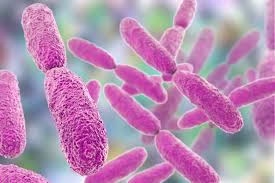
What are Microbes?
-
Microbes are organisms that can be observed only using:
-
Light microscope
-
Electron microscope
-
-
Major groups of microbes include:
-
Bacteria
-
Viruses
-
Fungi
-
Protozoa
-
Helminths (parasitic worms)
-
Algae (some are microscopic)
-
Prions (infectious proteins)
-
Basic Structure of Microbes
-
Microbes may contain the following structures depending on their type:
-
Cell wall
-
Cell membrane
-
Cytoplasm
-
Genetic material (DNA/RNA)
-
Ribosomes
-
Nucleus (in eukaryotic microbes)
-
Organelles (in eukaryotic microbes)
-
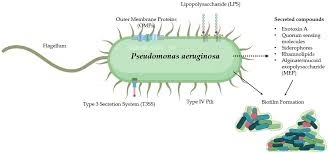
Surface structures such as capsule, pili, and flagella
-
Structure of Bacteria
-
Bacteria are prokaryotic organisms.
-
They do not have:
-
True nucleus
-
Membrane-bound organelles
-
-
Their genetic material is present as:
-
Single circular chromosome
-
Plasmids (extra DNA)
-
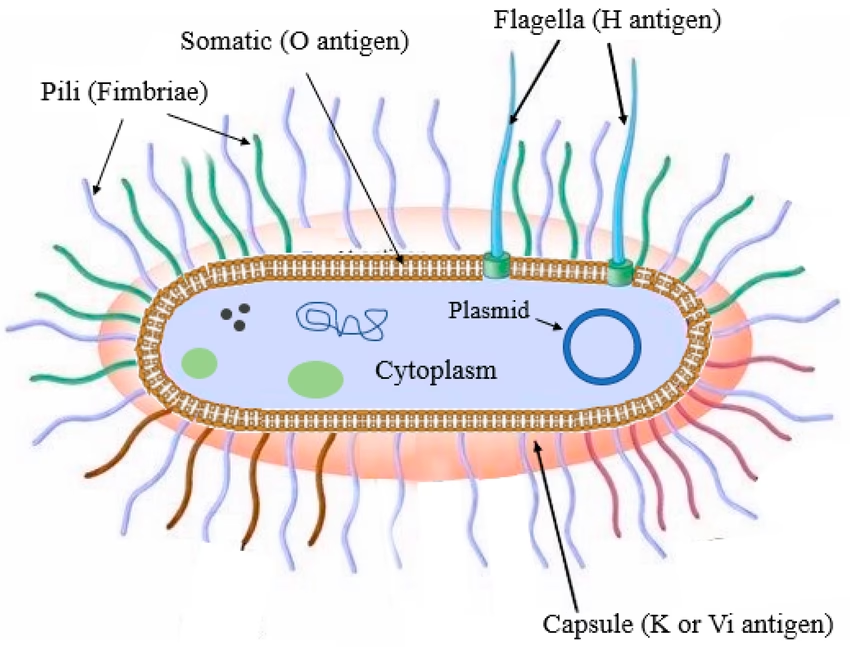
Main Components of the Bacterial Cell
Cell Wall
-
Gives bacteria:
-
Shape
-
Strength
-
Protection
-
-
Made mainly of peptidoglycan.
-
Important for:
-
Gram staining
-
Antibiotic action
-
Cell Membrane
-
Controls entry and exit of substances.
-
Contains enzymes for:
-
Respiration
-
Transport mechanisms
-
Cytoplasm
-
Semi-fluid part of cell containing:
-
Enzymes
-
Nutrients
-
Ribosomes
-
Inclusion bodies
-
Ribosomes
-
Type: 70S ribosomes
-
Function: protein synthesis
Nucleoid
-
Region containing bacterial DNA
-
No nuclear membrane
Capsule
-
Outer protective layer in some bacteria
-
Helps in:
-
Preventing phagocytosis
-
Increasing virulence
-
-
Example: Streptococcus pneumoniae
Flagella
-
Thread-like structures used for movement
-
Helps bacteria in motility
-
Different arrangements:
-
Single flagellum
-
Tuft at one end
-
Flagella at both ends
-
Flagella all around
-
Pili and Fimbriae
-
Hair-like structures
-
Functions:
-
Attachment to host tissues
-
Conjugation (DNA transfer)
-
Endospores
-
Dormant resistant structures produced by some bacteria
-
Highly resistant to:
-
Heat
-
Chemicals
-
Dryness
-
-
Examples:
-
Bacillus
-
Clostridium
-
Classification of Bacteria
Classification Based on Shape
-
Cocci (round)
-
Bacilli (rod-shaped)
-
Spiral forms:
-
Vibrio (comma shaped)
-
Spirillum (rigid spiral)
-
Spirochetes (flexible spiral)
-
Classification Based on Arrangement
-
Cocci:
-
Pairs (diplococci)
-
Chains (streptococci)
-
Clusters (staphylococci)
-
Groups of four (tetrads)
-
-
Bacilli:
-
Single rods
-
Chains (streptobacilli)
-
Short rods (coccobacilli)
-
Classification Based on Gram Staining
-
Gram-positive bacteria:
-
Thick peptidoglycan layer
-
Purple in Gram stain
-
-
Gram-negative bacteria:
-
Thin peptidoglycan layer
-
Outer membrane present
-
Pink/red in Gram stain
-
Classification Based on Oxygen Requirement
-
Aerobic bacteria (require oxygen)
-
Anaerobic bacteria (cannot survive in oxygen)
-
Facultative anaerobes (grow with or without oxygen)
-
Microaerophilic bacteria (need low oxygen)
-
Capnophilic bacteria (need increased CO₂)
Classification Based on Spore Formation
-
Spore-forming bacteria:
-
Bacillus
-
Clostridium
-
-
Non-spore forming bacteria:
-
E. coli
-
Staphylococcus
-
Structure of Viruses
-
Viruses are acellular (non-cellular).
-
They are smaller than bacteria.
-
They require living host cells to multiply.
-
They are called obligate intracellular parasites.
Main Components of Viruses
Genetic Material
-
Viruses contain either:
-
DNA
-
RNA
-
-
They never contain both together.
Capsid
-
Protein coat covering the nucleic acid
-
Protects viral genetic material
Envelope
-
Present in some viruses
-
Lipid layer derived from host cell membrane
-
Helps in viral entry into host cells
Classification of Viruses
Classification Based on Genetic Material
-
DNA viruses
-
RNA viruses
Classification Based on Envelope
-
Enveloped viruses
-
Non-enveloped viruses
Structure of Fungi
-
Fungi are eukaryotic microbes.
-
They have:
-
True nucleus
-
Membrane-bound organelles
-
-
Their cell wall is made of:
-
Chitin
-
Forms of Fungi
Yeast
-
Unicellular fungi
-
Reproduce by budding
-
Example: Candida
Mould
-
Multicellular fungi
-
Form hyphae and mycelium
-
Example: Aspergillus
Dimorphic Fungi
-
Exist as:
-
Yeast form in human body
-
Mould form in environment
-
-
Example: Histoplasma
Structure of Protozoa
-
Protozoa are unicellular eukaryotes.
-
They have:
-
Nucleus
-
Cytoplasm
-
Organelles
-
-
Many protozoa are parasitic.
Types of Protozoa Based on Locomotion
-
Amoebae (pseudopodia)
-
Flagellates (flagella)
-
Ciliates (cilia)
-
Sporozoa (non-motile)
Helminths (Parasitic Worms)
-
Helminths are multicellular parasites.
-
They are larger than typical microbes but studied in microbiology due to their disease-causing role.
-
Types include:
-
Nematodes (roundworms)
-
Cestodes (tapeworms)
-
Trematodes (flukes)
-
Prions
-
Prions are infectious protein particles.
-
They contain:
-
No DNA
-
No RNA
-
-
They cause fatal brain diseases.
-
Example:
-
Creutzfeldt–Jakob disease
-
Overall Classification of Microbes
Prokaryotic Microbes
-
Bacteria
Eukaryotic Microbes
-
Fungi
-
Protozoa
-
Helminths
-
Algae
Acellular Infectious Agents
-
Viruses
-
Prions
Importance of Classification of Microbes
-
Helps in:
-
Identification of microbes in laboratory
-
Selecting correct treatment
-
Understanding mode of transmission
-
Studying epidemiology
-
Preventing infections
-
Vaccine development
-