Introduction
-
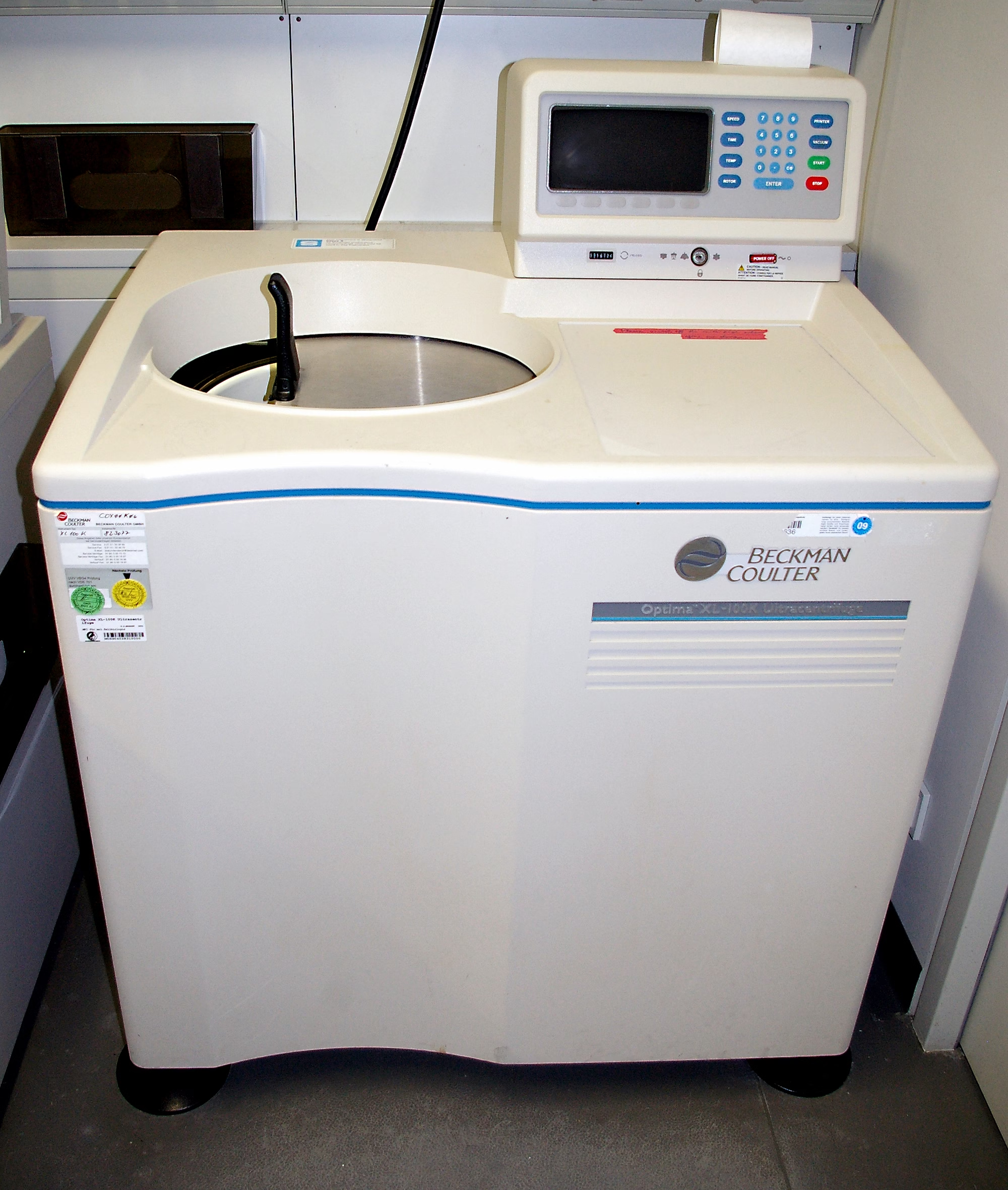
Ultracentrifugation is an advanced centrifugation technique used in laboratories to separate very small biological particles.
-
It is commonly used for the separation of proteins, nucleic acids, viruses, ribosomes, lipoproteins, and subcellular organelles.
-
The separation is based on differences in particle size, shape, and density.
-
In this method, samples are subjected to extremely high centrifugal force produced by very high-speed rotation.
-
Ultracentrifuges operate at speeds of about 50,000–150,000 rpm.
-
These instruments can generate centrifugal forces of approximately 100,000–1,000,000 × g.
-
Due to its high resolving power, ultracentrifugation can separate very small macromolecules and cellular components.
-
It is widely used in biochemistry, molecular biology, clinical biochemistry, virology, and cell biology for isolation, purification, and analysis of biological materials.
Principle
-
Ultracentrifugation works on the principle of sedimentation of particles under high centrifugal force.
-
When a mixture containing particles of different sizes and densities is rotated at very high speed, each particle experiences centrifugal force and moves outward from the center of rotation.
-
Larger and denser particles sediment faster and form a pellet at the bottom of the centrifuge tube.
-
Smaller or lighter particles remain suspended in the solution for a longer period.
-
Thus, particles are separated according to their sedimentation rate.
-
The rate of sedimentation depends on several factors such as:
-
Particle size
-
Particle density
-
Density and viscosity of the medium
-
Shape of the particle
-
Speed of rotation
-
-
The sedimentation rate of particles is expressed in Svedberg units (S), known as the sedimentation coefficient.
-
Example:
-
Ribosomes: 70S (prokaryotes) and 80S (eukaryotes)
-
Hemoglobin: about 4.5S.
-
The rate of sedimentation depends on several factors, including:
-
Size of the particle
-
Density of the particle
-
Density and viscosity of the medium
-
Shape of the particle
-
Speed of rotation of the centrifuge
The sedimentation rate of particles is expressed in Svedberg units (S), which represent the sedimentation coefficient of a particle.
Examples:
-
Ribosomes have sedimentation coefficients of 70S in prokaryotes and 80S in eukaryotes.
-
Hemoglobin has a sedimentation coefficient of approximately 4.5S.
Components
Rotor
-
-
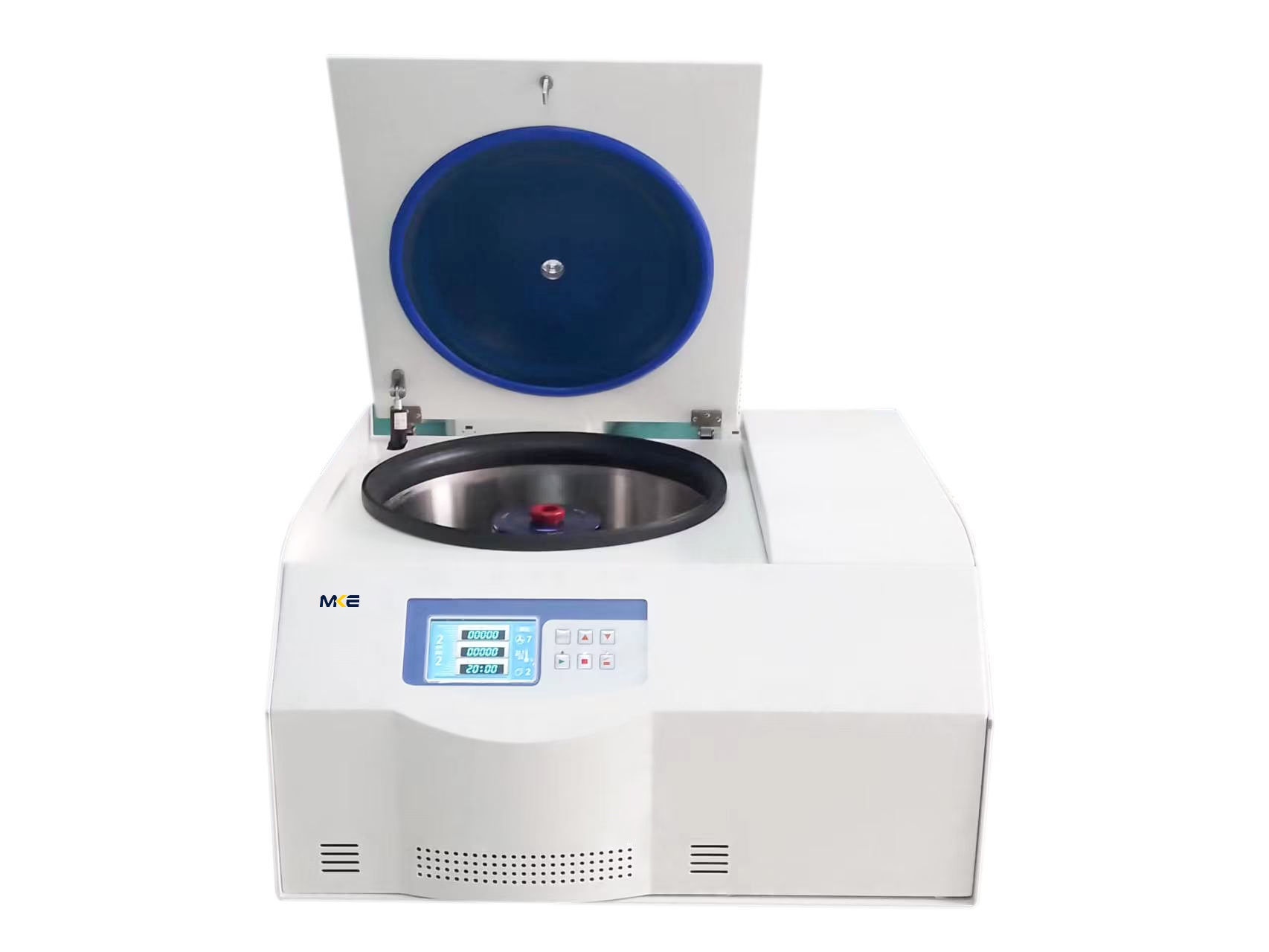
The rotor is the central rotating part of the ultracentrifuge that holds the sample tubes.
-
It is designed to withstand extremely high speeds.
-
Common types include fixed-angle rotors and swinging-bucket rotors.
-
Vacuum System
-
-
A vacuum system removes air from the centrifuge chamber.
-
This reduces air friction and prevents excessive heat generation during high-speed rotation.
-
Refrigeration System
-
-
Ultracentrifuges are usually equipped with a refrigeration system to maintain low temperatures, typically 0–4°C.
-
This prevents degradation of sensitive biological molecules such as proteins and nucleic acids.
-
High-Speed Motor
-
-
A powerful motor drives the rotor and allows it to rotate at extremely high speeds required for ultracentrifugation.
-
Control System
-
-
The control panel allows regulation of speed, temperature, and duration of centrifugation to ensure accurate and safe operation.
-
Types of Ultracentrifugation
Ultracentrifugation is broadly divided into two main types: Preparative ultracentrifugation and Analytical ultracentrifugation.
A. Preparative Ultracentrifugation
Preparative ultracentrifugation is used for the separation, isolation, and purification of biological particles. It is widely applied in biochemical and molecular biology research.
Two important methods are used in preparative ultracentrifugation:
1. Differential Ultracentrifugation
In this method, separation occurs mainly based on particle size and mass. The sample is centrifuged at progressively increasing speeds. Larger and heavier particles sediment first, while smaller particles remain in the supernatant.
For example, during cell fractionation, cellular components sediment in the following sequence:
-
Nuclei
-
Mitochondria
-
Lysosomes
-
Ribosomes
This technique is commonly used to isolate different cell organelles.
2. Density Gradient Ultracentrifugation
In this technique, separation occurs based on differences in particle density using a density gradient medium such as sucrose or cesium chloride (CsCl).
There are two types:
a. Rate-Zonal Centrifugation
-
Separation occurs based on particle size and sedimentation rate.
-
The sample is layered on top of a density gradient.
-
Larger particles move faster through the gradient than smaller ones.
b. Isopycnic Centrifugation
-
Separation occurs strictly according to particle density.
-
Particles migrate through the gradient until they reach a region where their density equals that of the surrounding medium.
-
At this point, sedimentation stops.
Example:
-
Separation of DNA using cesium chloride density gradient centrifugation.
B. Analytical Ultracentrifugation
Analytical ultracentrifugation is mainly used to study the physical and chemical properties of macromolecules rather than simply isolating them.
It provides valuable information about:
-
Molecular weight of macromolecules
-
Molecular shape and structure
-
Molecular interactions
-
Purity and homogeneity of proteins
Analytical ultracentrifuges are equipped with optical detection systems, such as absorbance or interference optics, that allow continuous monitoring of sedimentation during centrifugation.
Applications
In Biochemistry
-
Isolation and purification of proteins
-
Separation of lipoproteins
-
Study of enzyme complexes and macromolecular structures
In Molecular Biology
-
Purification of DNA and RNA
-
Ribosome analysis
-
Isolation and purification of viruses
In Clinical Biochemistry
-
Separation of plasma lipoproteins such as HDL, LDL, and VLDL
-
Analysis of plasma protein fractions
In Virology
-
Isolation, purification, and concentration of viruses for research and vaccine development
In Cell Biology
-
Isolation of cell organelles such as:
-
Mitochondria
-
Lysosomes
-
Microsomes
-
Ribosomes
-
Advantages
-
Provides very high resolution separation of particles.
-
Capable of separating extremely small macromolecules and subcellular structures.
-
Essential technique in biochemistry and molecular biology research.
-
Allows accurate study of molecular size, density, and interactions.
Limitations
-
Ultracentrifuge instruments are very expensive.
-
Operation requires skilled personnel and careful handling.
-
Extremely high speed may damage delicate biological structures.
-
Proper sample preparation is necessary to obtain reliable results.