Introduction
- Parasitic infections are common health problems in many parts of the world, especially in tropical and developing countries.
- These infections are caused by different types of parasites such as protozoa, helminths, and ectoparasites.
- Accurate diagnosis of parasitic diseases mainly depends on proper collection, preservation, transportation, and processing of clinical samples.
- In parasitology laboratories, the quality of the sample is extremely important.
- Even if advanced laboratory methods are available, incorrect collection or delayed processing of specimens may lead to false-negative results.
- Many parasites are delicate and may lose their shape or motility if the sample is not handled properly.

The laboratory diagnosis of parasitic infections may involve detection of:
- Adult worms
- Eggs (ova)
- Larvae
- Cysts
- Trophozoites
- Oocysts
- Parasite antigens
Types of Specimens Used in Parasitology
Different clinical specimens are used depending on the parasite suspected.
| Specimen | Common Parasites |
|---|---|
| Stool | Amoeba, Giardia, hookworm, Ascaris |
| Blood | Malaria parasite, microfilaria |
| Urine | Schistosoma haematobium |
| Sputum | Paragonimus westermani |
| CSF | Trypanosomes |
| Skin scraping | Scabies, Leishmania |
| Tissue biopsy | Tissue parasites |
Collection of Stool Samples
Stool examination is the most commonly performed investigation in parasitology because many intestinal parasites are detected in feces.
Instructions for Stool Collection
- Stool should be collected in a clean, dry, leak-proof container.
- Freshly passed stool is preferred.
- Avoid contamination with:
- Urine
- Water
- Soil
- Disinfectants
Amount of Sample
Approximately:
- 5–10 grams of stool is sufficient.
Timing of Examination
Fresh stool should ideally be examined immediately because trophozoites lose motility quickly.
Recommended timing:
- Within 30 minutes for trophozoites
- Within 1–2 hours for ova and cysts
Important Precautions
Patients should avoid:
- Laxatives
- Antidiarrheal drugs
- Barium studies before stool examination
Sometimes parasites are not shed continuously, so a single stool sample may not be enough.
Usually:
- Three stool samples collected on alternate days are recommended.
Collection of Blood Samples
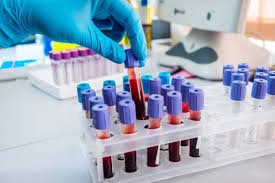
Common Blood Parasites
- Plasmodium species (malaria)
- Microfilariae
- Trypanosomes
- Babesia
Methods of Blood Collection
Finger Prick Method
Used for:
- Thick blood smear
- Thin blood smear
Venous Blood Collection
Used for:
- Concentration methods
- Serological tests
- PCR and molecular diagnosis
Timing of Blood Collection
Timing is very important for some parasites.
Example:
Microfilariae of Wuchereria bancrofti show:
- Nocturnal periodicity
Therefore:
- Blood should be collected during night hours.
Collection of Urine Samples
Urine examination helps diagnose certain urinary parasites.
Example:
- Schistosoma haematobium
Collection Method
- Midday urine is preferred.
- A terminal urine sample is more useful because eggs are concentrated in the last portion of urine.
Collection of Sputum Samples
Sputum examination may help identify certain parasites.
Examples:
- Paragonimus westermani
- Strongyloides stercoralis
Collection Instructions
- Early morning sputum is preferred.
- Deep cough specimen should be collected.
Saliva should not be used because it may dilute the specimen.
Collection of CSF Samples
Cerebrospinal fluid examination may be required in:
- African sleeping sickness
- Amoebic meningoencephalitis
These samples should be processed immediately because parasites may deteriorate rapidly.
Preservation of Samples
The main goals of preservation are:
- Prevent degeneration of parasites
- Maintain parasite morphology
- Prevent bacterial overgrowth
- Allow transportation to laboratory
Common Preservatives Used in Parasitology
1. Formalin (10%)
Commonly used preservative for:
- Ova
- Cysts
- Larvae
Advantages
- Preserves morphology well
- Useful for concentration techniques
2. Polyvinyl Alcohol (PVA)
Mainly used for:
- Protozoal trophozoites
Advantages
- Preserves nuclear details clearly
3. Sodium Acetate–Acetic Acid–Formalin (SAF)
A commonly used universal preservative.
Advantages
- Good preservation
- Useful for staining procedures
4. Potassium Dichromate
Used mainly for:
- Coccidian parasites
Examples:
- Cryptosporidium
- Cyclospora
- Isospora
Storage and Transportation of Samples
Proper transportation and storage are very important.
General Guidelines
- Fresh samples are always preferred.
- If delay occurs, specimens should be refrigerated at 2–8°C.
- Avoid freezing unless specifically recommended.
- Samples should be transported quickly.
Labelling of Samples
Every sample container should contain:
- Patient name
- Age and sex
- Date and time of collection
- Type of specimen
Improper labeling may lead to reporting errors.
Processing of Stool Samples
1. Macroscopic Examination
The stool is examined visually for:
- Color
- Consistency
- Blood
- Mucus
- Adult worms
- Tapeworm segments
Loose stool may indicate active trophozoites.
2. Microscopic Examination
Microscopy is the most important part of parasitic diagnosis.
Saline Wet Mount
Used for:
- Detecting motile trophozoites
- Observing larvae
Iodine Wet Mount
Used for:
- Demonstrating cyst morphology
- Showing nuclear details
3. Concentration Techniques
These methods increase parasite recovery when organisms are present in small numbers.
Sedimentation Technique
Useful for:
- Heavy eggs
- Larvae
Flotation Technique
Useful for:
- Light eggs
- Protozoal cysts
4. Permanent Staining Methods
Used for accurate identification of protozoa.
Common stains:
- Trichrome stain
- Iron hematoxylin stain
These stains clearly demonstrate internal structures.
Processing of Blood Samples
Thick Blood Smear
Advantages:
- More sensitive
- Detects low parasitemia
Used mainly for:
- Malaria screening
Thin Blood Smear
Advantages:
- Helps identify species of parasite
- Shows morphology clearly
Staining Methods
Common stains include:
- Giemsa stain
- Leishman stain
These stains help visualize blood parasites clearly.
MCQs
1. Which specimen is most commonly used for diagnosis of intestinal parasites?
A. Blood
B. Urine
C. Stool
D. Sputum
Answer: C. Stool
2. Fresh stool examination is important mainly for detecting:
A. Ova
B. Cysts
C. Trophozoites
D. Larvae
Answer: C. Trophozoites
3. The ideal container for stool collection is:
A. Dirty bottle
B. Clean dry container
C. Open tray
D. Plastic bag
Answer: B. Clean dry container
4. Stool samples should not be contaminated with:
A. Blood
B. Water
C. Parasites
D. Mucus
Answer: B. Water
5. Multiple stool samples are recommended because:
A. Parasites multiply rapidly
B. Parasite shedding may be intermittent
C. Stool is always contaminated
D. Ova are difficult to stain
Answer: B. Parasite shedding may be intermittent
6. The most common preservative used in parasitology is:
A. Ethanol
B. Formalin
C. Acetone
D. Methanol
Answer: B. Formalin
7. Which preservative is commonly used for protozoal trophozoites?
A. PVA
B. Formalin
C. Saline
D. Acetic acid
Answer: A. PVA
8. Potassium dichromate is commonly used for preservation of:
A. Helminths
B. Blood parasites
C. Coccidian parasites
D. Fungi
Answer: C. Coccidian parasites
9. Thick blood smear is mainly used for:
A. Species identification
B. Increased sensitivity
C. Bacterial culture
D. Urine examination
Answer: B. Increased sensitivity
10. Thin blood smear is mainly useful for:
A. Detecting bacteria
B. Species identification
C. Stool examination
D. Urine analysis
Answer: B. Species identification
11. The commonly used stain for malaria parasites is:
A. Gram stain
B. Ziehl-Neelsen stain
C. Giemsa stain
D. Albert stain
Answer: C. Giemsa stain
12. Blood collection for microfilaria is commonly done during:
A. Morning
B. Afternoon
C. Night
D. Evening only
Answer: C. Night
13. Which parasite shows nocturnal periodicity?
A. Giardia lamblia
B. Entamoeba histolytica
C. Wuchereria bancrofti
D. Ascaris lumbricoides
Answer: C. Wuchereria bancrofti
14. Midday urine sample is preferred for diagnosis of:
A. Malaria
B. Schistosoma haematobium
C. Hookworm
D. Filariasis
Answer: B. Schistosoma haematobium
15. Saline wet mount is mainly used to detect:
A. Motility of trophozoites
B. Bacterial colonies
C. Fungal spores
D. Viral particles
Answer: A. Motility of trophozoites
16. Iodine wet mount is useful for demonstrating:
A. RBC morphology
B. Cyst structures
C. Fungal hyphae
D. Platelets
Answer: B. Cyst structures
17. Which concentration technique is useful for heavy eggs?
A. Flotation method
B. Sedimentation method
C. Smear method
D. Culture method
Answer: B. Sedimentation method
18. Flotation technique is mainly useful for:
A. Heavy ova
B. Light eggs and cysts
C. Bacteria
D. Tissue parasites
Answer: B. Light eggs and cysts
19. Trichrome stain is mainly used for:
A. Blood parasites
B. Protozoal identification
C. Fungal culture
D. Bacterial staining
Answer: B. Protozoal identification
20. Which specimen is used for diagnosis of malaria?
A. Stool
B. Urine
C. Blood
D. CSF
Answer: C. Blood
21. The ideal temperature for refrigerated storage of specimens is:
A. -20°C
B. 37°C
C. 2–8°C
D. 60°C
Answer: C. 2–8°C
22. Which specimen is commonly used for diagnosis of intestinal amoebiasis?
A. Blood
B. Stool
C. Sputum
D. CSF
Answer: B. Stool
23. The main purpose of sample preservation is to:
A. Destroy parasites
B. Increase contamination
C. Maintain morphology
D. Reduce sample volume
Answer: C. Maintain morphology
24. Which of the following may interfere with stool examination?
A. Water contamination
B. Clean container
C. Fresh sample
D. Proper labeling
Answer: A. Water contamination
25. CSF examination may be useful in diagnosis of:
A. Malaria
B. Amoebic meningoencephalitis
C. Hookworm infection
D. Giardiasis
Answer: B. Amoebic meningoencephalitis
26. Which specimen is used for Paragonimus westermani diagnosis?
A. Blood
B. Stool
C. Sputum
D. Urine
Answer: C. Sputum
27. Formalin preserves mainly:
A. Ova and cysts
B. Viruses only
C. Platelets
D. RBCs only
Answer: A. Ova and cysts
28. The parasite detected in skin scrapings is:
A. Plasmodium
B. Scabies mite
C. Giardia
D. Hookworm
Answer: B. Scabies mite
29. Which method is highly sensitive for detecting low parasitemia in malaria?
A. Thin smear
B. Thick smear
C. Culture
D. ELISA
Answer: B. Thick smear
30. A leak-proof container is important to:
A. Prevent contamination
B. Increase parasite growth
C. Reduce staining
D. Prevent fixation
Answer: A. Prevent contamination
31. Which parasite is commonly detected in urine?
A. Giardia
B. Schistosoma haematobium
C. Ascaris
D. Entamoeba
Answer: B. Schistosoma haematobium
32. PCR in parasitology is used for:
A. Culture preparation
B. DNA detection
C. Gram staining
D. Platelet count
Answer: B. DNA detection
33. ELISA is an example of:
A. Microscopy
B. Serological test
C. Culture method
D. Wet mount
Answer: B. Serological test
34. Which stool consistency commonly contains trophozoites?
A. Formed stool
B. Loose stool
C. Dry stool
D. Hard stool
Answer: B. Loose stool
35. Adult worms may sometimes be seen during:
A. Microscopic examination
B. Macroscopic examination
C. PCR testing
D. ELISA
Answer: B. Macroscopic examination
36. The purpose of concentration techniques is to:
A. Destroy parasites
B. Increase recovery of parasites
C. Sterilize samples
D. Remove RBCs
Answer: B. Increase recovery of parasites
37. Which stain is commonly used for blood parasites?
A. Giemsa stain
B. Gram stain
C. Ziehl-Neelsen stain
D. Lactophenol cotton blue
Answer: A. Giemsa stain
38. Samples should be properly labeled with:
A. Patient details
B. Date and time
C. Specimen type
D. All of the above
Answer: D. All of the above
39. Which of the following is NOT a common parasitology specimen?
A. Stool
B. Blood
C. Urine
D. Hair oil
Answer: D. Hair oil
40. Delayed processing may cause loss of:
A. Parasite motility
B. RBC count
C. Platelet count
D. Hemoglobin
Answer: A. Parasite motility
41. The direct saline mount is prepared mainly to observe:
A. Motility
B. Crystal formation
C. Bacterial culture
D. Viral particles
Answer: A. Motility
42. Stool examination for ova and parasites is commonly abbreviated as:
A. CBC
B. O&P
C. ESR
D. RFT
Answer: B. O&P
43. Which specimen should be processed immediately for parasite motility?
A. Old stool
B. Fresh stool
C. Preserved stool
D. Frozen stool
Answer: B. Fresh stool
44. Which of the following improves diagnostic accuracy in intestinal parasitosis?
A. Single sample only
B. Multiple stool samples
C. Delayed examination
D. Improper storage
Answer: B. Multiple stool samples
45. Which technique is used for species identification in malaria?
A. Thick smear
B. Thin smear
C. Wet mount
D. Culture
Answer: B. Thin smear
46. The main aim of preservation is to prevent:
A. Morphological changes
B. Staining
C. Labeling
D. Blood collection
Answer: A. Morphological changes
47. Which sample is useful for diagnosing tissue parasites?
A. Biopsy
B. Saliva
C. Sweat
D. Tears
Answer: A. Biopsy
48. Which preservative is called a universal preservative in parasitology?
A. SAF
B. Ethanol
C. Formalin only
D. Acetone
Answer: A. SAF
49. One of the most common causes of false-negative parasitic diagnosis is:
A. Proper labeling
B. Fresh sample
C. Improper specimen handling
D. Immediate examination
Answer: C. Improper specimen handling
50. Proper collection and preservation of samples mainly help in:
A. Destroying parasites
B. Accurate diagnosis
C. Reducing laboratory work
D. Preventing staining
Answer: B. Accurate diagnosis