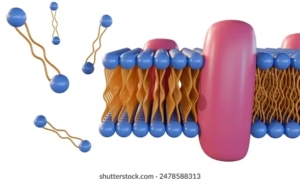
Definition Lipids are a heterogeneous group of organic compounds that are insoluble in water but soluble in nonpolar solvents (like chloroform, ether, benzene). They are composed mainly of carbon, hydrogen, Read More ……..
Simplifying Allied Health Learning.
Definition Lipids are a heterogeneous group of organic compounds that are insoluble in water but soluble in nonpolar solvents (like chloroform, ether, benzene). They are composed mainly of carbon, hydrogen, Read More ……..
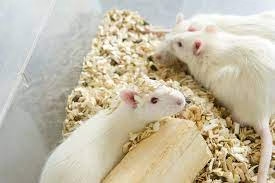
Introduction Care and handling of laboratory animals requires careful attention to ethical standards, health, welfare, and scientific integrity. Proper care ensures accurate scientific outcomes, promotes the welfare of the animals, Read More ……..
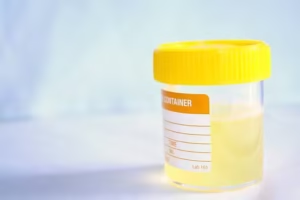
Introduction Accurate microbiological diagnosis depends largely on the quality of the clinical sample that reaches the laboratory. The process begins not in the lab but at the bedside or clinic, Read More ……..
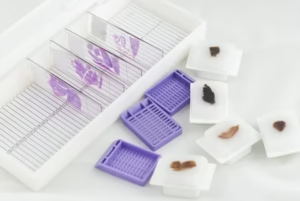
AIM: Gross Examination of Histopathological Specimens Principle The principle of gross examination of histopathology involves the visual and tactile assessment of tissue specimens before they undergo microscopic examination. The primary Read More ……..
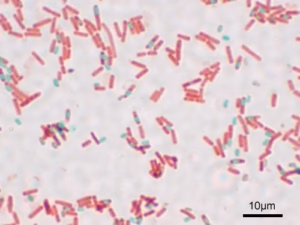
Introduction The principle of staining methods in the microbiology lab, like Gram staining, is a fundamental laboratory technique used to classify bacteria into two major groups: Gram-positive and Gram-negative. Developed by Hans Christian Read More ……..