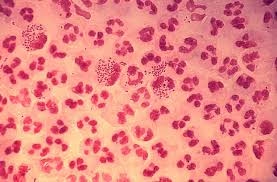
Introduction Gonorrhea is a common sexually transmitted infection (STI) caused by the bacterium Neisseria gonorrhoeae. It has significant health implications due to its potential to cause severe complications if left Read More ……..
Simplifying Allied Health Learning.
Introduction Gonorrhea is a common sexually transmitted infection (STI) caused by the bacterium Neisseria gonorrhoeae. It has significant health implications due to its potential to cause severe complications if left Read More ……..

Introduction Syphilis is caused by Treponema pallidum, a spirochete bacterium. It is primarily transmitted through sexual contact but can also be passed from mother to child during pregnancy (congenital syphilis). Read More ……..
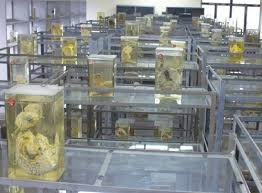
Museum techniques in histopathology are meticulous procedures used to preserve, display, and maintain biological specimens for long-term use in educational, research, and historical contexts. These techniques cover various specimen types Read More ……..
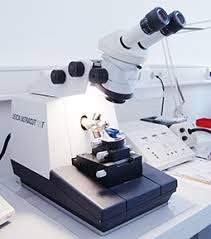
Ultramicrotomy is a precision technique used in electron microscopy to prepare ultra-thin slices (sections) of specimens. These thin sections are essential for techniques like transmission electron microscopy (TEM), where the Read More ……..

Electron microscopy is a powerful imaging technique that uses electron beams instead of light to achieve high-resolution images of specimens at the nanometer scale. This allows for detailed visualization of Read More ……..