Introduction
- Disinfectants are chemical agents used to destroy pathogenic microorganisms on non-living surfaces.
- Before a disinfectant is used in hospitals, laboratories, or public health settings, its effectiveness must be tested.
- Standard laboratory tests are used to compare the germicidal activity of disinfectants under controlled conditions.
- Two classical methods commonly described in microbiology are:
- Rideal–Walker Test
- Chick–Martin Test
These tests help determine how effective a disinfectant is compared with phenol.
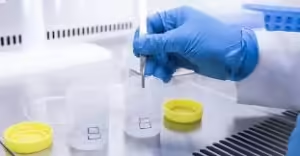
Rideal-Walker Test
Principle
- Serial dilutions of disinfectant and phenol are prepared.
- Equal volume of bacterial culture is added to each dilution.
- The highest dilution that kills the organism in 7.5 minutes but not in 5 minutes is determined.
- The same is done with phenol.
- The ratio of the two gives the phenol coefficient.
Formula
Phenol Coefficient = Highest dilution of disinfectant killing organism in 7.5 min but not in 5 min / Highest dilution of phenol killing organism in 7.5 min but not in 5 min
Materials Required
- Pure culture of Salmonella Typhi
- Phenol solution
- Test disinfectant
- Sterile nutrient broth tubes
- Pipettes
- Water bath at 37°C
- Stopwatch
Procedure
- Selection of Bacteria: The test traditionally uses Salmonella typhi as the test organism, though other bacteria may be substituted depending on the specific application.
- Preparation of Dilutions:
- A series of dilutions of the disinfectant being tested and phenol are prepared in sterile water.
- Standard concentrations often start from 1:10 and can go up to 1:800, though this may vary based on the disinfectant’s expected potency.
- Each dilution is maintained in a separate test tube.
- Addition of Bacterial Culture:
- A standardized inoculum (a specific concentration of bacteria) is added to each dilution of disinfectant and phenol.
- The bacterial suspension is generally prepared in nutrient broth and then added to disinfectant or phenol tubes.
- Timed Exposures:
- A loopful from each test tube is transferred to a neutralizing broth at intervals of 2.5, 5, 7.5, and 10 minutes. This step neutralizes the disinfectant’s activity and allows any bacteria that survived the disinfectant exposure to grow.
- The neutralization ensures that disinfectant action ceases upon transfer, preventing false results due to continued action during incubation.
- Incubation and Observation:
- The inoculated neutralizing media tubes are incubated at an appropriate temperature (usually 37°C for human pathogens) for 48 hours.
- After incubation, each tube is observed for growth, typically indicated by turbidity or cloudiness in the medium. Clear tubes indicate the disinfectant killed all the bacteria at that dilution and exposure time.
- Determination of Phenol Coefficient:
- The phenol coefficient is calculated by identifying the highest dilution of the disinfectant that kills the bacteria in 7.5 minutes but not in 5 minutes and comparing it to phenol’s corresponding effective dilution.
- Formula:
Phenol Coefficient = Effective Dilution of Disinfectant / Effective Dilution of Phenol
Observation
- Clear broth = no bacterial growth (organism killed)
- Turbid broth = bacterial growth present
Interpretation
- Find highest dilution killing bacteria at 7.5 minutes but not at 5 minutes
- Calculate phenol coefficient
- Phenol Coefficient > 1: The disinfectant is more effective than phenol.
- Phenol Coefficient < 1: The disinfectant is less effective than phenol.
- Phenol Coefficient = 1: The disinfectant is equally as effective as phenol.
Modifications and Limitations
- Adaptations: Variants of the Rideal-Walker test sometimes use other bacteria, such as Staphylococcus aureus or Escherichia coli, for broader applicability.
- Limitations:
- Only one type of bacteria and controlled lab conditions are used, limiting relevance in real-world applications.
- The test may not accurately reflect the disinfectant’s performance in environments with organic matter or different microbial compositions.
Chick-Martin Test
Principle
- Serial dilutions of disinfectant and phenol are prepared.
- Organic matter is added to each tube.
- A standard bacterial culture is added.
- The highest dilution that kills bacteria in 7.5 minutes but not in 5 minutes is determined.
- The same procedure is performed with phenol.
- The ratio gives the phenol coefficient.
Formula
Phenol Coefficient = Highest dilution of disinfectant killing organism in 7.5 min but not in 5 min / Highest dilution of phenol killing organism in 7.5 min but not in 5 min
Why Organic Matter is Added
- In practical conditions disinfectants act in presence of:
- Blood
- Pus
- Sputum
- Tissue debris
- Organic matter may reduce disinfectant activity.
Materials Required
- Test disinfectant
- Phenol solution
- Standard bacterial culture (usually Salmonella Typhi)
- Sterile nutrient broth
- Organic matter (yeast suspension or fecal suspension)
- Pipettes
- Water bath at 37°C
Procedure
- Bacterial Selection: Like the Rideal-Walker test, Salmonella typhi is commonly used. However, other pathogens can also be tested depending on the disinfectant’s intended application.
- Addition of Organic Matter:
- A 5% solution of organic matter, commonly peptone or even sterilized feces, is added to the bacterial suspension. This simulates conditions where organic debris is present, providing a realistic challenge to the disinfectant.
- Preparation of Disinfectant Dilutions:
- Disinfectants are diluted to a series of concentrations, similar to the Rideal-Walker test.
- Each dilution is added to test tubes containing the bacterial suspension with organic matter.
- Exposure and Neutralization:
- The bacterial suspension is exposed to each disinfectant dilution for 30 minutes.
- After exposure, samples from each dilution are transferred to a neutralizing broth, which halts any further activity of the disinfectant.
- Incubation and Evaluation:
- Samples are incubated for 48 hours, and growth is observed.
- Like in the Rideal-Walker test, the effective dilution that prevents growth within the exposure time is recorded and compared to phenol.
Observation
- Clear broth = no growth
- Turbid broth = bacterial growth present
Interpretation
- Determine highest dilution killing bacteria in 7.5 minutes but not in 5 minutes
- Calculate phenol coefficient
Calculation of Phenol Coefficient
- Similar to the Rideal-Walker test, the phenol coefficient here is a ratio comparing the effectiveness of the disinfectant to phenol but in the presence of organic matter.
Advantages and Limitations
- Realistic Testing: Including organic material allows a better assessment of disinfectant efficacy in complex environments.
- Limitations:
- It only uses one concentration (5%) of organic matter, which may not represent the diversity of real-world situations.
- Extended exposure times (typically 30 minutes) may not reflect shorter contact times in practical settings.
In-Use Test
The in-use test evaluates disinfectants in real-life settings, providing insights into their effectiveness under actual application conditions, such as in healthcare, laboratory, or food processing environments.
Purpose
- To determine whether a disinfectant remains effective when applied in the actual conditions of use, considering factors like dilution accuracy, contamination over time, and presence of organic load.
- This test is particularly valuable in monitoring disinfectants already in use in facilities to ensure they are achieving expected microbial control.
Procedure
- Sampling of Disinfectant Solution:
- Samples of the disinfectant solution are collected from the actual point of use (e.g., mop bucket, dispenser).
- Sampling should be done under standard working conditions, at regular intervals, to account for dilution errors, degradation, or contamination.
- Neutralization and Dilution:
- The disinfectant sample is neutralized immediately after sampling. This stops its action, allowing for an accurate count of any surviving bacteria.
- Neutralization can be done using specific chemical agents designed to inactivate the disinfectant without harming any surviving bacteria.
- Microbial Culture:
- An inoculum of known bacteria, often including pathogens relevant to the setting, is added to the disinfectant-neutralized sample.
- This is then cultured on selective media to allow growth of any bacteria that survived the disinfectant’s action.
- Incubation and Observation:
- Samples are incubated under appropriate conditions for the bacteria involved (e.g., 37°C for 24-48 hours for most pathogens).
- Any bacterial growth indicates that the disinfectant was ineffective under the tested conditions.
Interpretation
- No Growth: Indicates that the disinfectant is effective and maintains sufficient potency in real-use conditions.
- Growth Present: Signifies a potential issue, such as improper dilution, contamination, or insufficient active ingredients, indicating that the disinfectant may need adjustment or replacement.
Advantages and Limitations
- Reflects Practical Conditions: The in-use test directly evaluates disinfectant performance in the environment where it is used, providing realistic results that lab-based tests cannot fully capture.
- Potential for Contamination: Because samples are taken in situ, there’s a risk of environmental contamination affecting results.
- Complex Interpretation: Results may vary significantly based on environmental factors, making it necessary to conduct multiple tests to confirm findings.